
Williams Warrant Checks
Begin with the court printed on the citation or notice. Williams Municipal Court handles city matters, while Williams Justice Court handles its county docket. Have the full name, date of birth, case number, charge date, and citation number ready.
- Read the court name and case identifier on the record.
- Use Arizona Public Access as a case lead.
- Call the named Williams court at the number on its current individual page.
- Use the Sheriff records route for a historical enforcement record.
- Check Arizona DPS as a limited statewide lead, then discuss resolution with counsel.
Neither state tool replaces the Williams clerk. Public Access is a case-search lead, and DPS warns that its results are informational. Confirm any match and any apparent absence with the court that issued the warrant.
Williams Warrant Contacts Conflict
Both individual court pages currently list 700 W. Railroad Avenue and 928-679-7698. Other official directories have published alternatives, including 928-635-2691 and 928-635-4456. That discrepancy is useful, not trivial. Call before traveling and ask which office now holds the case.
Check first: Use the latest individual court page, then verify the address, phone, hours, and court name with the clerk.
Do not treat a disconnected number as proof that the case moved or closed. Official pages can update at different times. Record which office answered and when the warrant status was checked.
Policing and Warrants in Williams
The municipal judge issues city-court warrants. Williams police may execute a valid order but cannot quash it or decide the underlying charge. The Williams Police Department lists 501 W. Route 66 and non-emergency service at 928-635-4461.
Use police for a safety or agency matter, not as a substitute for a court status call. A person checking their own Williams warrant can contact the court or an attorney before approaching law enforcement. The judge's court remains the source for bond, appearance, payment, and quash instructions.
Williams Justice and City Warrants
The shared Railroad Avenue address can hide an important split. Williams Municipal Court controls city violations. Williams Justice Court controls county traffic and misdemeanor matters assigned to that precinct. A payment, filing, or phone call directed to one court does not alter the other's warrant.
The official Justice Court source preserves its contact and Public Access direction.
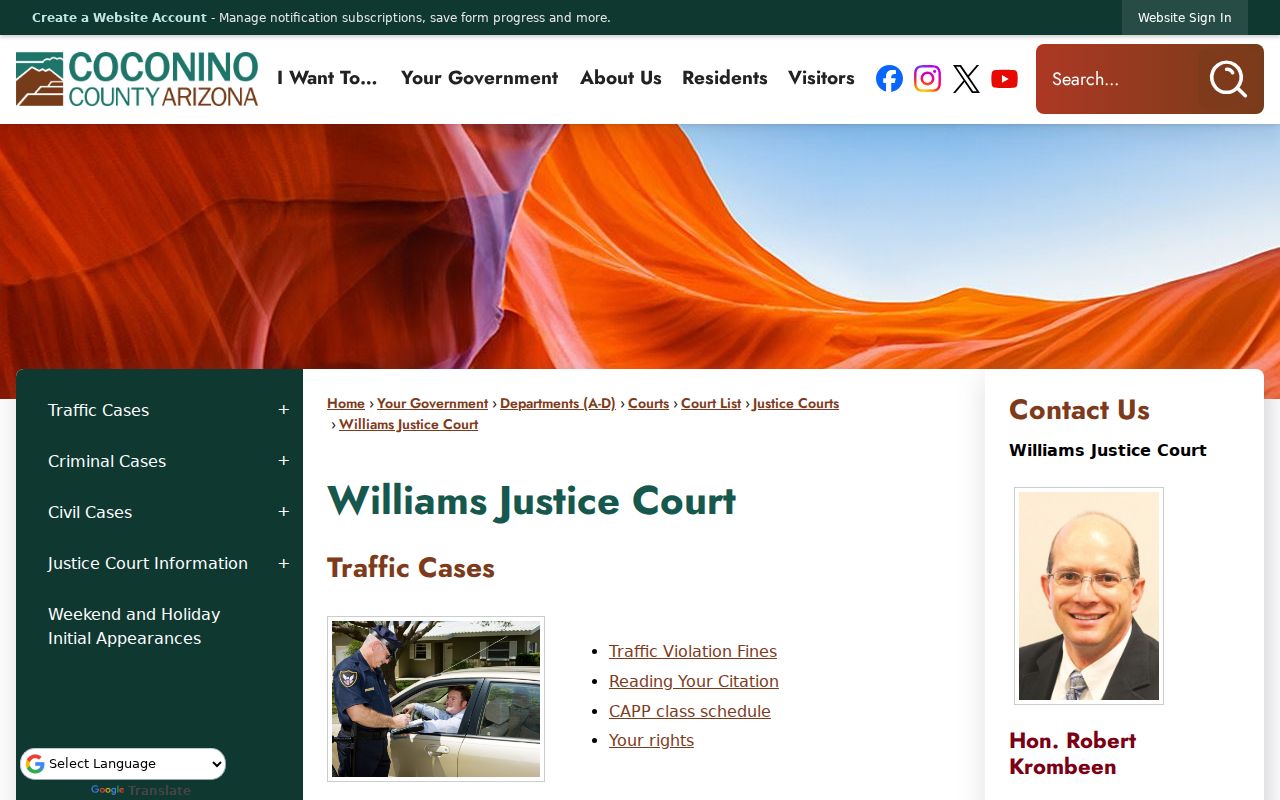
That court source should be checked again when directory entries disagree.
| Record says | First route |
|---|---|
| Williams Municipal Court | City court clerk |
| Williams Justice Court | Justice Court clerk |
| Coconino Superior Court | Clerk of Superior Court |
Repeat the full court name when calling. Ask staff to confirm the case number and jurisdiction before discussing any payment or appearance.
Warrants in Williams: The Main Types
Williams warrant type follows the underlying obligation. A missed required setting may lead to a bench warrant. An arrest warrant rests on a probable-cause finding. Civil traffic default follows a separate non-warrant path.
| Warrant Type | How It Arises | Who Issues It |
|---|---|---|
| Criminal traffic bench warrant | Missed required appearance | Municipal or Justice Court |
| City-code warrant | Unmet city-court obligation | Williams Municipal Court |
| Misdemeanor FTA warrant | Missed criminal setting | Court holding the case |
| Arrest warrant | Sworn probable-cause basis | Authorized magistrate |
Do not infer the warrant type from an amount due. The docket and issuing order show whether the matter is a civil default, a bench warrant, or an arrest warrant.
Williams Criminal Traffic Warrants
Coconino traffic guidance distinguishes civil from criminal citations. An unanswered civil ticket may result in default, added fees, and a motor vehicle consequence. Missing a required criminal appearance can lead to a bench warrant and failure-to-appear action.
Williams criminal traffic guidance uses court-specific appearance and pretrial procedures. Ask the named court whether a request must be filed before the setting and whether attendance remains required. A pending request does not equal judicial approval. If the date passed, ask directly if a warrant issued.
The distinction matters after payment too. Clearing a balance does not always quash a Williams warrant or end an appearance duty. Confirm each status separately.
Williams Warrant Records: What They Show
A public case lead can connect the warrant to its docket, but fields and timing vary. Copy the court name and identifiers exactly, then ask the clerk to confirm current status.
| Case or warrant ID | The true identifier, shown here only as WILLIAMS CASE ID. |
|---|---|
| Name | The person linked to the case, subject to restrictions. |
| Charge | The traffic, misdemeanor, or city-code allegation. |
| Issuing court | Municipal, Justice, or another named court. |
| Bond or amount | A court-set field when public; verify before paying. |
| Status | Active, served, or quashed, confirmed by the court. |
Williams Warrant Payment Is Not Status
The official Williams court pages link Public Access and payment services, including Arizona CourtPay and a Williams payment site. Those tools perform different jobs. Public Access is a case lookup. A vendor takes an authorized payment. Neither is a guaranteed live warrant-status system.
The official Municipal Court source documents its contact and payment routes.
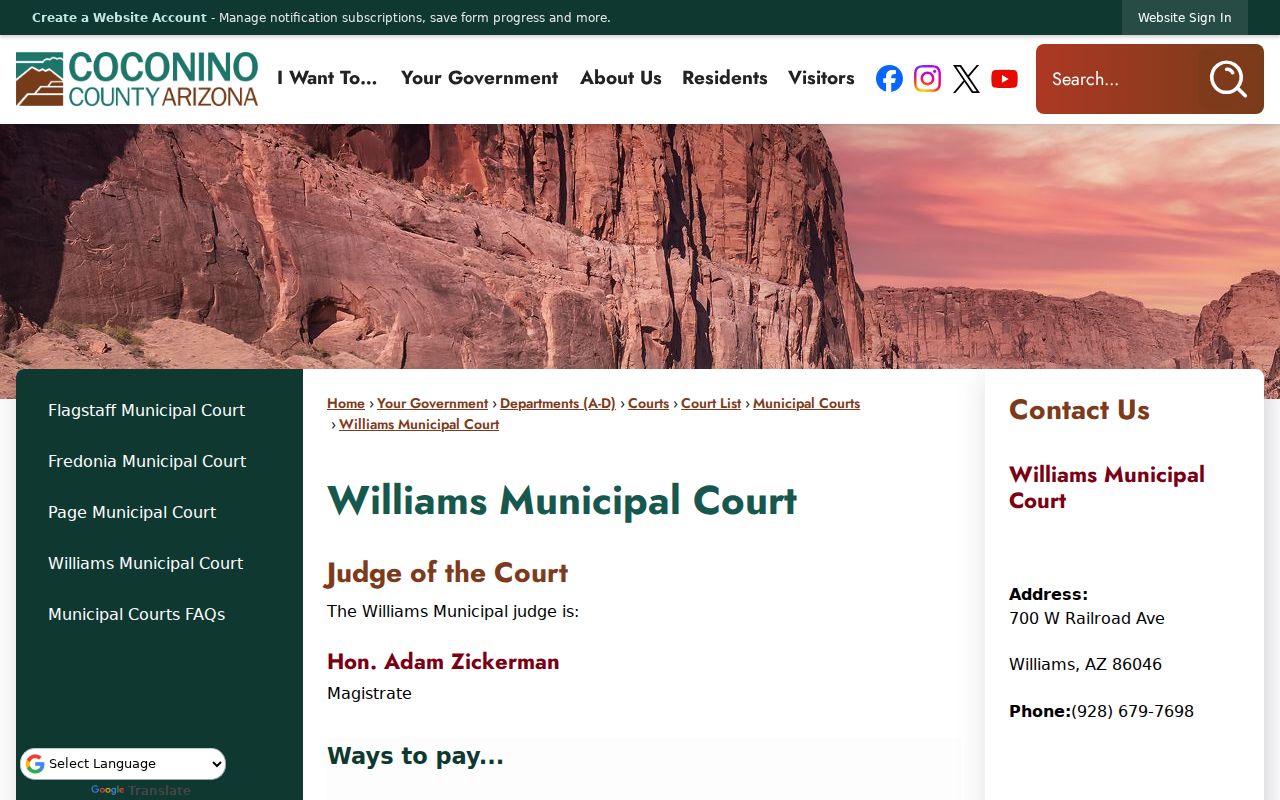
The payment links shown there still require a separate current warrant-status check.
Before paying, confirm the court, case, exact amount, and whether payment is an allowed resolution. Ask whether a court appearance, plea, bond, or judge's order is also required. After the transaction, request confirmation that the warrant was quashed. Quashed means canceled by the judge.
Keep the receipt and court response together. A zero balance cannot prove that a separate Williams bench warrant is no longer active.
Williams Warrants and Coconino County
A Williams city warrant begins with Municipal Court. A Justice Court warrant remains with that county court. Sheriff deputies may serve warrants, and Arizona databases may carry a lead, but neither changes the issuing judge's authority over status and quashing.
Warrant flow: Williams court / police › Coconino County Sheriff › Arizona DPS warrant information
The Coconino County warrant records overview explains countywide routes. Return to the named Williams court for the final status.
Williams Warrant Scam Checks
Williams police warn about callers seeking money for warrants or subpoenas. A threat of immediate arrest and demand for fast payment should trigger independent verification. End the call. Find the court's official page yourself and call its published number.
Do not pay the caller: Confirm the Williams warrant, case number, amount, and approved payment channel directly with the issuing court.
A real case may exist while the payment demand is still fraudulent. Do not use information supplied by the caller as the sole proof. Court staff can confirm whether a balance, bond, hearing, or warrant is actually recorded.
Accessing Williams Warrant Records
Arizona Public Records Law supports access to non-exempt records, but sealed and juvenile material stays restricted. Public Access uses a CAPTCHA, updates on a weekly cycle, excludes protected categories, and disclaims official completeness. A blank result is not proof that no Williams warrant exists.
Key Rules:
Arizona Public Records Law, A.R.S. §39-121 permits inspection of non-exempt public records.
A.R.S. §39-121.01 addresses prompt access, copies, and sufficiently specific requests.
A.R.S. §8-208 limits access to juvenile records.
Request a narrow record from the issuing Williams court: the warrant entry, issue date, status date, bond field, and quash order for a known case. Use Sheriff Records for a historical enforcement file, not live court clearance. Last checked September 9, 2026.
Williams Rural Warrant Resolution
Coconino County Justice Bus events can bring eligible court services closer to rural communities. Event notices identify participating courts, place, date, and accepted payment forms. They are not standing amnesty promises. Check the current Justice Bus calendar and confirm Williams court participation.
A walk-in event may offer a route to ask for warrant quashing, a plea change, or another listed service. The judge still controls relief, and some warrants or jurisdictions may not qualify. Tribal, federal, and neighboring-county matters must go to their own courts.
Bring the case number and approved payment form, but do not assume payment alone clears the warrant. Obtain a current court-status response after the event.
Williams Warrant Search Limits
Arizona Public Access is a useful first screen because both Williams court pages point readers toward case lookup. It is not a dedicated active-warrant list. The system covers most Arizona courts, requires users to solve a CAPTCHA, and receives scheduled updates rather than live changes. It also excludes sealed, juvenile, protection-order, mental-health, probate, victim, witness, and some ordinance information. Search by the known case number when possible, then compare the displayed court with the paper citation.
The Arizona DPS search uses first name, last name, and date of birth. It limits the matches displayed and warns that its information may not be current or complete. That makes a result a lead for court confirmation. It also makes an empty result inconclusive. No official current Williams police or court warrant roster was located during research.
If one system shows activity and another does not, do not choose the more convenient answer. Call the issuing court, state both results, and ask staff to check the warrant register and docket. Record the date of confirmation because status can change after surrender, service, payment, or a judge's quash order.
Williams Warrant Requests by Record Type
A live status question and a public-record request serve different needs. For immediate status, call the Municipal or Justice Court. For a document, identify the Williams court, case number, date range, and exact item sought. Useful items include the warrant entry, issuance date, current status field, bond information, minute entry, disposition, and any order recalling or quashing the warrant.
Ask for non-exempt, redacted records. Social Security numbers, full birth dates, home addresses, photographs, and unrelated personal details are not needed to verify a known case. If the custodian withholds material, ask for the statutory or rule basis and whether a redacted version can be supplied. Fees depend on the custodian and record type; research found no one countywide warrant-record fee.
A Williams police report may document the incident or service of a warrant. It cannot prove that the court later canceled the order. Likewise, a payment receipt proves a transaction, not the present warrant status. Pair the document with a current clerk response. This distinction keeps a historical record from being mistaken for a live clearance.
Missing a Williams Court Date
Act before the setting when possible. Read the notice for the full court name, then ask that clerk about the required continuance or pretrial procedure. Submit any request through the official route, keep proof of delivery, and verify whether the judge granted it. The original duty to appear remains unless the court changes it.
After a missed date, ask four direct questions: whether a warrant issued, whether a new failure-to-appear allegation was added, whether bond is set, and what filing or appearance can place the matter before the judge. A clerk can state the procedure but cannot promise relief. An attorney can help evaluate a criminal traffic or misdemeanor matter and arrange a safer appearance or surrender.
Once action is taken, request confirmation that the Williams warrant was quashed rather than merely that a motion was filed or money was received. A docket can show each step at a different time. The final status entry and signed order are stronger evidence than an assumption based on disappearance from an online result.
Williams Warrant Verification Checklist
Before ending a status call, repeat the full court name, case number, warrant type, current status, and status date. Ask whether an appearance remains set, whether bond is required, and whether the judge entered a signed quash order. If the clerk gives a new address or phone number, compare it with the individual court page and note the discrepancy.
These steps matter in Williams because official directory entries have not always matched. Keep the clerk's response with the citation, filed motion, and any receipt. Recheck shortly before travel or surrender because service, a new order, or data reporting can change the record.