
Inside the Coconino County Most Wanted Program
The Sheriff's Wanted Persons/Warrant Tips page is the official starting point for Coconino County. Its name suggests a roster, but the page offers none. There is no searchable list, no downloadable active-warrant file, and no update schedule. Instead, it serves as a public-safety tip channel and sends readers to Arizona Public Access for court information. That distinction matters more than it looks. A tip page lets a witness pass useful facts to law enforcement; it cannot confirm that a named person has an active warrant. Behind the scenes, the Warrants Section maintains, enters, and clears warrants from Coconino County Superior Court, Flagstaff City Court, and the Flagstaff, Fredonia, Page, and Williams Justice Courts. Still, the issuing court alone speaks with authority on a warrant's legal status. Names, portraits, and mugshots have no place in a responsible account of the Coconino County most wanted program, so none appear here. Use the official Sheriff link, then verify any warrant question with its court.
Coconino County Official Tip Route
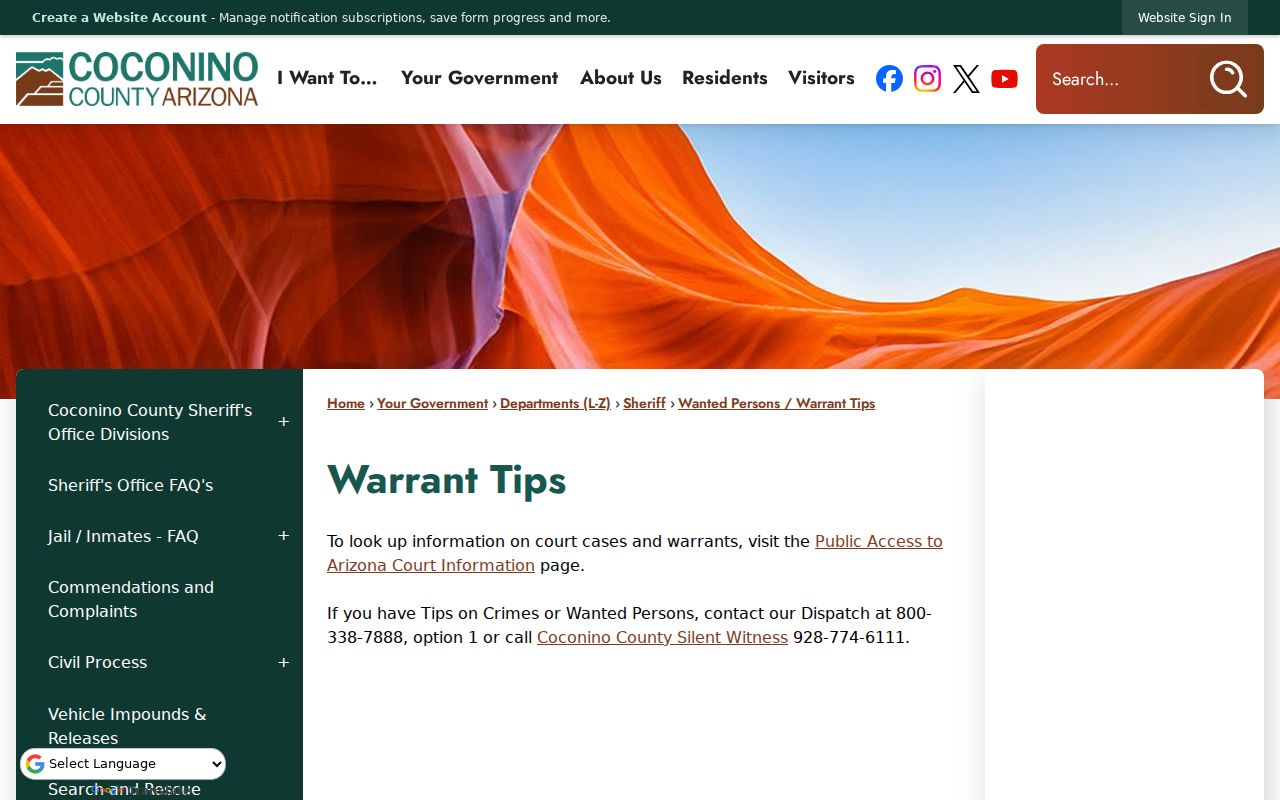
The Sheriff's official tip page lays out three ways to report what you know. Sheriff dispatch answers at 928-774-4523, option 1. The toll-free route is 800-338-7888, option 1. Coconino County Silent Witness takes tips at 928-774-6111. These lines exist for facts that might help law enforcement, not for warrant confirmation, so keep case-status questions away from them and take those to the courts instead.
The split here is simple. Tips go to the Sheriff or Silent Witness; questions about whether a Coconino County warrant still stands go to the court records and the issuing clerk. Each channel has its own job. Note: A tip is not a request to search Coconino County warrant records.
How Coconino County Most Wanted Lists Work
Most-wanted pages are curated, not complete. They highlight a handful of high-priority active warrants rather than every outstanding warrant in the county. Coconino County publishes no countywide wanted roster of that kind. That does not mean the Sheriff holds no warrants. It means the public channel works differently: the Sheriff keeps covered warrant entries for operations, the courts keep case records, and the wanted-person feature exists mainly to gather tips. Status shifts too. An arrest, a surrender, a recall, or a quash by a judge can end a warrant, yet an old docket line or a shared post can linger online after that. A fresh warrant can also lag before any public system shows it. For current status on a Coconino County warrant, name the court and call its clerk.
Note: A published item can lag, and a missing item does not prove that no Coconino County warrant exists.
Coconino County Statewide Warrant Check
The Arizona DPS Warrant Search casts the widest net. Enter a first name, last name, and date of birth, and it returns no more than five records. DPS itself warns that court-supplied data may be stale, incomplete, or not real-time. A possible match is not a positive identification. Even police cannot treat that public result alone as grounds for arrest. The Arizona Public Access to Court Information tool offers a different angle on a Coconino County warrant check. It is a CAPTCHA-protected case lookup, updated weekly, covering most Arizona courts. It can surface case activity or a docket reference tied to a warrant, though it is no most wanted list for Coconino County. Sealed, juvenile, protection-order, victim or witness, mental-health, probate, and other excluded data will not appear.
- Start with a case or citation number when available.
- Use DPS for its limited statewide warrant-information check.
- Use Public Access to identify case activity and the court.
- Call the issuing clerk to confirm current warrant status.
Sending a Most Wanted Tip Safely
Keep a tip short and factual. Note the place, the time, the direction of travel, vehicle details, or the conduct you saw, and leave rumor out. Never post a person's location online. If there is an immediate threat, call 911. Otherwise, reach the Coconino County Sheriff through the dispatch, toll-free, or Silent Witness contact published on the official county page.
- Move to a safe place. Do not approach or alert the person.
- Choose an official number from the Sheriff page, not a social post.
- Describe what you directly saw and where it occurred.
- Follow the dispatcher’s directions and do not pursue.
Coconino County posts no reward structure for tips, and no route is promised anonymity. Assume neither. Ask the operator how your chosen channel handles caller information.
Key Point: Report clear facts through an official channel, then step away. Never confront, follow, photograph, or detain anyone.
Coconino County Court Confirmation
The Coconino County Court List sorts the courthouse map: one Superior Court, four Justice Courts, and five Municipal Courts. The Coconino County Clerk of the Superior Court holds Superior Court records, which include felony and serious criminal matters. Flagstaff, Fredonia, Page, Williams, and Sedona each have limited-jurisdiction clerks who keep their own misdemeanor, traffic, petty-offense, and city cases. Ask the right court directly whether a warrant is active, served, recalled, or quashed, and when that status changed. The Sheriff can explain its enforcement and record role, but only a judicial officer in the issuing jurisdiction can quash a warrant. Calling the wrong court may yield no file even though the case sits elsewhere. Flagstaff Municipal Court runs a Warrant Officer route for city matters; its pages suggest a case search, direct court contact, bond where applicable, or scheduling an appearance before a judge. Contact numbers have varied over time, so confirm the current one, and the location, before you travel.
How Most Wanted Differs From an Active Warrant
A most-wanted page and an active warrant are two different things. The feature highlights a handful of picked names. An active warrant is any court order that has not been served, and most of them never make a public lineup. Coconino County posts no official warrant roster, so a missing name proves nothing either way.
| Feature | Most-wanted feature | Active warrant |
|---|---|---|
| Scope | Selected public-safety cases | Any warrant still in force |
| Coconino access | No official roster located | DPS and case activity are leads |
| Status authority | Agency controls its post | Issuing court confirms status |
| Public action | Send a safe official tip | Contact court or counsel |
The Sheriff can enter and clear covered warrants without publishing them. A Public Access docket is not an order to arrest anyone. Coconino County readers should judge each source by what it actually claims to do.
Coconino County Redacted Record Requests
Arizona public-records law lets you inspect and copy non-exempt records, and a narrowly drawn request works best here. Ask for aggregate data, a blank warrant-register schema, or a redacted status history rather than a mass list of private people. The Sheriff Records Requests page routes Sheriff material through shared Flagstaff Records, and requests are accepted online, in person, and by mail. Records sits at 911 E. Sawmill Road in Flagstaff, with phone 928-214-2530 and fax 928-779-2703. When you write the request, name the court, the record series, the case number if you have it, the date range, and the fields you want, such as issue date, status date, and clearance date. The public form is built around reports, so put a precise warrant request under “Other.” Ask for a fee estimate too, since Coconino County lists no dedicated warrant-status fee. Expect some material to stay private: juvenile, sealed, investigative, victim or witness information, and identifying details may be withheld or redacted under Arizona public-records law and other limits. A partial response can reflect a legal restriction or a different office, not the absence of a warrant.
Coconino County Warrant Scam Warning
Urgency is the tell of a scam. Coconino County warned in September 2025 about a caller posing as a Jury Commissioner, threatening a warrant, and fishing for personal information. The court said it does not operate that way. A demand for instant payment, account data, gift cards, or personal details is not proof of a warrant. Hang up instead. Find the court through the official courts directory, then dial the number yourself. Payment portals are court-specific and are not warrant searches. Paying a fine also may not cancel a warrant that already issued, because a judge may require an appearance first.
When You Believe You Are Listed
A rumor or an old photo is not enough to act on, and the absence of a public Coconino County most wanted roster proves nothing either way. Pull your facts together first. The case number, the citation, the court name, and the date give any lawyer what she needs to call the issuing court, check the warrant's status, and plan a voluntary appearance that will not end in a surprise arrest. The court itself can tell you whether a bond, a motion, or a hearing applies to your matter, so treat the Sheriff tip line as a place to report crime, not the place to resolve your own case. Help with travel exists too. The Justice Bus and certain walk-in events sometimes serve eligible Superior, Justice, or Municipal Court matters in rural parts of Coconino County, and the current Justice Bus calendar shows what is coming up. Call the clerk before you count on any single event, since one scheduled stop is not blanket amnesty. And a fine paid at the window does not always recall a warrant; only the issuing court can confirm that it did.
Important: Contact a lawyer and the issuing court before appearing. They can verify status and plan a safe, lawful response.
Coconino County Jurisdiction Boundaries
A Coconino County address does not make every warrant a county matter. City courts run municipal cases. Tribal courts handle their own, and federal cases go through the District of Arizona and the federal dockets. The U.S. Marshals Service District of Arizona lists Flagstaff office and task-force contacts plus a federal tip line, but that task force is not a county warrant database. Sort the case by the name on the warrant, citation, or docket. Then use that jurisdiction’s official clerk and enforcement channels. Arizona DPS may offer a statewide lead, yet its result cannot show every county, tribal, city, or federal warrant.