
Page Warrant Checks
For a warrant check in Page, go straight to the source: the Page Magistrate Court. That is the office a person calls. Gather the full name, date of birth, case or citation number, and the date of any missed setting before dialing. The court handles city criminal and civil traffic matters, misdemeanors, and city-code cases. Only its judge can confirm whether a Page warrant was issued, or quashed.
- Read the court name and case number on the citation, summons, or notice.
- Search Arizona Public Access for a case lead after completing its CAPTCHA.
- Call Page Magistrate Court at 928-645-4280 for current city-case and warrant status.
- For a Page Justice Court matter, use the county court directory instead.
- Check the Arizona DPS warrant tool as a limited statewide lead, then consult counsel about resolution.
Page Magistrate Court Status Calls
Page makes the city route unusually easy. City Attorney guidance directs anyone with a criminal or traffic matter to call 928-645-4280, whether to check on it or resolve it. The Magistrate Court sits at 547 Vista Avenue and posts hours of 7 a.m. to 5:30 p.m., Monday through Thursday. Schedules shift, so confirm before you drive over. The official Page court source spells out its jurisdiction, contact details, and payment options.
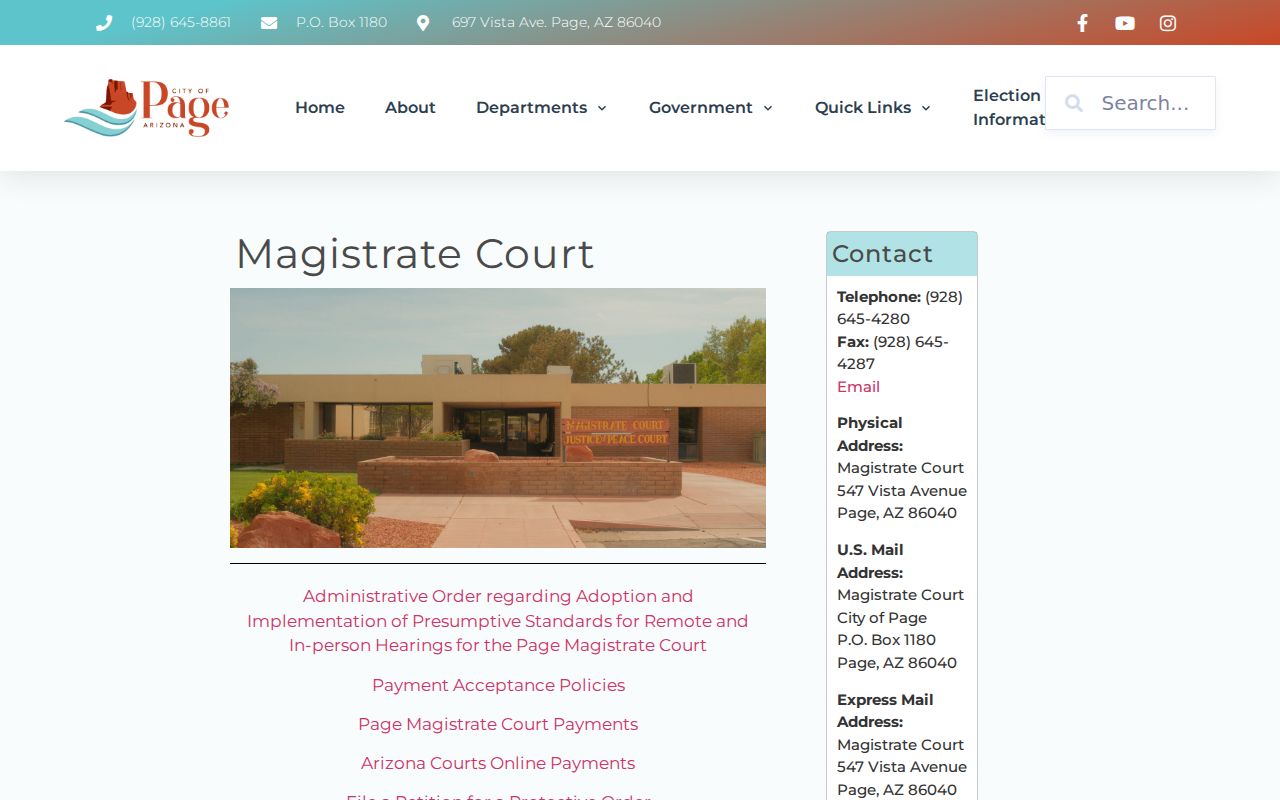
That source is a court contact route, not a public active-warrant roster.
Key point: Ask the clerk separately about the case, warrant, next appearance, bond, and any written motion. One answer may not settle all five.
Page publishes no official roster of active warrants. So a blank web search proves nothing. The court's own answer is the real Page warrant record check. When you call, keep the questions tight. Ask which court and case number control the matter, whether a bench or arrest warrant is active, when the status was checked, and whether the judge requires an appearance. Then ask if bond, payment, or a written request can resolve it. Write down the instructions, and request a public copy if you need documentation.
Policing and Warrants in Page
The Page Magistrate Court decides city cases and issues its warrants. Page Police may serve one, but the department does not rule on the charge or cancel the judge's order. The City Attorney page lists Page Police at 928-645-2462, an agency contact rather than the place to settle a court status. For an immediate safety issue, use emergency services. For your own Page warrant, calling the court or a lawyer beats walking up to a police counter blind to the warrant status or bond terms. A quash is a judicial cancellation, and only the issuing court can confirm that step.
Page Continuance Requests Before Warrants
A continuance asks the judge to move a hearing. Page guidance requires a written request, and it must carry the person's name, case number, desired date, and reason, along with the required delivery and copy route. Sending the request grants nothing. Until the court approves it, the original duty to appear still stands, so anyone who cannot attend should contact the Page court early, keep a copy of the filing, and verify the ruling. If the date has already passed, ask whether a warrant issued and what motion or appearance is now required. Used on time, this local process can prevent a Page bench warrant. It will not erase one after issuance. Note: a clerk gives procedure and status information, while the judge decides whether to continue a case or quash a warrant.
Warrants in Page: The Main Types
Every warrant record in Page traces back to the authority and case behind it. City traffic, misdemeanor, and code matters land in Magistrate Court. County charges may belong to Page Justice Court or Superior Court. The label on the record tells you which route to take.
| Warrant Type | How It Arises | Who Issues It |
|---|---|---|
| Traffic bench warrant | Missed required criminal traffic date | Page Magistrate Court |
| City-code warrant | Failure to meet a required city-court obligation | Page Magistrate Court |
| FTA bench warrant | Missed misdemeanor or criminal setting | Judge handling the Page case |
| Arrest warrant | Probable-cause finding on a criminal allegation | Authorized magistrate or county court |
Page Traffic Cases Need Classification
A civil traffic default is not a criminal traffic warrant. An ignored civil citation can bring a default judgment, added fees, and a license consequence. Missing a required criminal appearance can bring a bench warrant plus another failure-to-appear penalty. Ask the Page clerk whether the count is civil or criminal before picking payment or a hearing. The court's payment links move authorized funds only. They are not warrant searches, and a receipt alone does not prove a judge quashed anything, so verify warrant status after the transaction and ask whether an appearance is still due. For more detail, see the Coconino County traffic warrant guidance.
Page Warrant Records: What They Show
A Page court record can tie a warrant to its case, though public fields vary. Copy identifiers exactly and confirm current status with the clerk, since statewide tools disclaim real-time completeness.
| Case or warrant ID | The actual local identifier, represented here as PAGE CASE ID. |
|---|---|
| Name | The person associated with the case, subject to access limits. |
| Charge | The city traffic, misdemeanor, or code allegation. |
| Issuing court | Page Magistrate Court or another named court. |
| Bond or amount | A court-set figure when public; confirm before acting. |
| Status | Active, served, or quashed, with the court as final source. |
Page Walk-In Warrant Resolution
Page has offered walk-in court services with no appointment needed for those eligible to quash a warrant. The Page walk-in notice spells out how that access works. It does not promise a walk-in event runs every day, so check with the court first.
Terms and dates change, so confirm them with the court before you drive anywhere. Coconino County's Justice Bus also brings court services to rural spots on a schedule, and each notice lists which courts take part and what they handle. A Page stop is not a catch-all. It may not cover every city, Justice, tribal, or federal warrant, so ask whether Page Magistrate Court participates and whether your specific warrant qualifies.
Page Warrant Payments Need Confirmation
A payment link on the Page court site does one job: it moves the money. It cannot decide whether you must appear, whether bond applies, or whether a Page warrant was quashed. Call the clerk first. Confirm the exact amount. Ask which payment route the court permits. After paying, get written confirmation of both the case balance and the current warrant status, since a payment screen is not a ruling. If an Arizona motor vehicle action grew out of a traffic case, ask what notice the court sends and whether another step remains. Never pay a caller who threatens arrest. End the call and dial the official Page court number yourself. Payment, bond, and quashing answer different questions. Payment covers an amount the court permits. Bond may secure release or a later appearance under the judge's terms. A quash order cancels the warrant. Ask for the order date and the clerk's current warrant-status entry before you treat the matter as closed.
Page Warrants and Coconino County
Page Magistrate Court and Page Justice Court are two different doors. A city case stays with the city judge. The county Justice Court runs its own traffic and misdemeanor docket. The Sheriff Warrants Section holds warrants for named county courts, and Arizona systems may carry a broader lead. Status and quashing still rest with the issuing court alone.
Warrant flow: Page Magistrate Court / Police › Coconino County Sheriff › Arizona DPS warrant information
For countywide routes, start with the Coconino County warrant records overview. Geography sets a trap. Distance never moves a city case to Flagstaff. After an arrest, Page may use county detention or sheriff services while keeping full control of its own docket. Tribal, federal, and neighboring-county warrants sit outside the Page city system. Each belongs to its named jurisdiction. The court printed on the Page record gives the final answer.
Page Records Requests Are Case-Specific
A status call only goes so far. Then request a Page court record, not a broad police file. Name the court, the case or citation number, and a date range. List what you want. Options include the docket, the warrant entry, a quash order, or the disposition. Ask the Page court for non-exempt, redacted material, and skip extra personal identifiers. The Sheriff Records route documents past enforcement. It does not replace the Page judge's current warrant entry. Arizona Public Access is only a lead: it uses a CAPTCHA, updates on a schedule, covers most courts but not all, and excludes sealed, juvenile, protection-order, and other protected matters. A blank screen cannot establish that no Page warrant exists. Split the live question from the document request. Ask the clerk whether the Page warrant is active today. In writing, seek the warrant-register entry, the issue date, the status date, the bond field, and any quash order for that case. A lawful fee may apply. Page sets no single warrant-record fee. Request an estimate before ordering a large file. A police report can describe an enforcement event. It cannot establish that the Page judge later changed the warrant, and a docket may show a motion filed without showing it was granted. Pair every Page record with current clerk confirmation.
Accessing Page Warrant Records
Arizona Public Records Law opens non-exempt government records. It does not turn restricted court data into a public roster. Page court staff may withhold or redact sealed, juvenile, victim, witness, and other protected details. Ask for the narrow record you need, and request the legal basis for any denial.
Key Rules:
A.R.S. §39-121 supports inspection and copying of non-exempt public records.
A.R.S. §39-121.01 addresses prompt access, copies, and sufficiently specific requests.
A.R.S. §8-208 places special limits on juvenile records.
Public tools have real limits. A warrant can be new, sealed, based outside Page, or delayed in a statewide feed. DPS caps the matches it displays and calls its data informational. Public Access updates on a weekly cycle. It is not a live warrant index. For a relative's Page case, give only the identifiers requested. Protected details stay confidential. A precise request protects accuracy too. Give the Page Magistrate Court enough detail to find one case without asking for a broad list of people. Useful fields include the case number, citation date, issuing court, warrant issue date, current status, status date, and any public quash order. If the clerk redirects you, note which office now holds the Page record and use that office's official route. Public access never authorizes sealed material. Juvenile case restrictions stay in force. When a Page online result and a clerk response differ, trust the court. Court confirmation matters most. Also verify Page court hours, contacts, payment links, and event eligibility before relying on them. Keep the Page court's reply with any payment receipt or filed motion. That paper trail separates a pending request from an order the judge has signed and entered.